
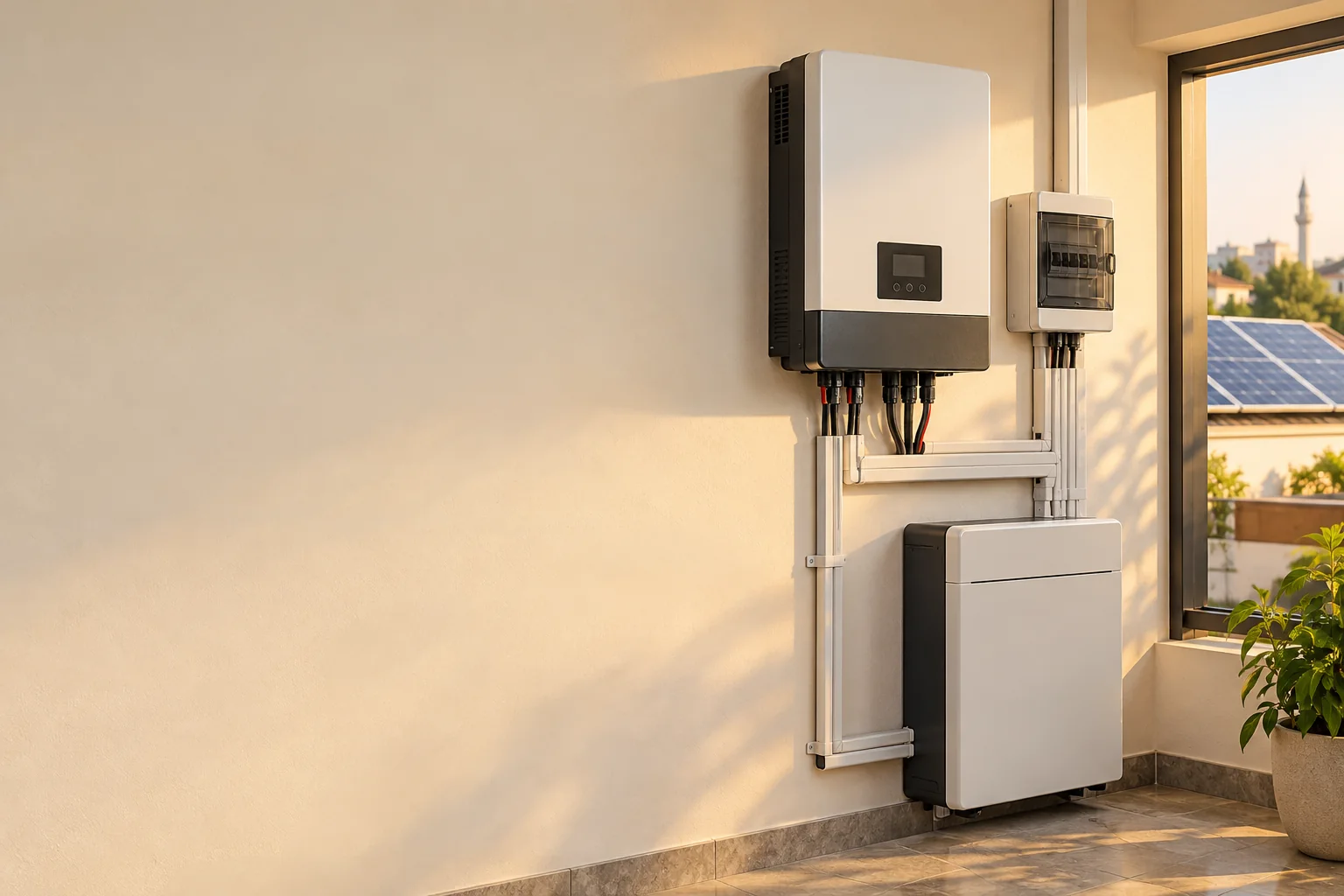
Current model comparison
Off-Grid Solar Inverter Price Table – Updated 16 October 2026
Compare the stated rating, supply phase, MPPT count and warranty. Prices exclude batteries and installation unless a quotation says otherwise.
| Brand / model | Stated capacity | Type / Phase / MPPT | Inverter price | Warranty |
|---|---|---|---|---|
| Tesla VMII 6000 48V | 5.6kW | Off-grid | Rs. 95,000 | |
| Tesla VMIII | 6kW | Off-grid | Rs. 105,000 | |
| Crown Xavier 1.5kW | 1.5kW | Off-grid | Rs. 60,000 | |
| Crown Xavier 3kW | 3kW | Off-grid | Rs. 76,000 |
4 off-grid models listed.
No matching off-grid models are listed. Clear the filters or request a quotation for your required specification.
Confirm the full model suffix, revision, stock, delivered price and service channel. A “+” price is a starting figure with no stated upper bound. kVA listings retain their stated rating and should not be treated as equal kW output.
What Is an Off-Grid Solar Inverter?
An off-grid inverter converts DC power into AC for local appliances without relying on a live utility grid. In a battery-based system, storage supplies the inverter while the array and solar charge controller replenish the battery.
Some units combine the inverter, battery charger and MPPT solar controller in one enclosure. Others need separate charging equipment. An inverter/charger may accept grid or generator power for charging; this does not automatically mean it can export electricity.
For a remote site, design around daily energy use and periods of low sunlight. For home backup, identify the essential circuits and intended runtime instead of assuming the inverter will support every appliance.
Victron’s off-grid home guide shows how the array, controller, battery and inverter/charger fit together.
Estimate Battery Energy for Your Off-Grid Loads
Set an average AC load and backup duration to estimate the nominal battery energy needed when there is no solar contribution.
Nominal battery estimate
5.56 kWhAt your selected load
4.0 hoursNominal battery energy = load × hours ÷ usable fraction ÷ efficiency.
The defaults are adjustable assumptions, not a recommended battery specification. Use the actual manufacturer’s usable capacity and conversion performance. Allow separately for reserve energy, ageing, temperature and inverter idle consumption.
Energy capacity does not establish discharge power. Check inverter continuous output, motor surge, battery/BMS current and cabling independently. This estimate does not size the solar array or establish year-round autonomy.
Stored energy and discharge power
Battery Compatibility for Off-Grid Inverters
The battery must provide both enough energy for runtime and enough power for the connected loads.
Voltage and Chemistry
Match the inverter’s DC voltage range, supported chemistry and charge settings. Do not mix different voltage platforms or assume any nominally matching battery is compatible.
Usable Capacity
Compare usable kWh rather than Ah alone. Nominal energy depends on voltage and Ah, while permitted depth of discharge and system losses reduce the energy available to appliances.
BMS and Discharge Current
Check sustained and surge discharge current, communication requirements and cut-off behavior. A large battery can still be unable to start a heavy motor or sustain a high simultaneous load.
Expansion and Maintenance
Follow approved series/parallel arrangements, cable protection and battery ventilation requirements. Confirm compatible expansion and maintenance before relying on future additions.
MPPT, Solar Charging and Generator Input
Built-In or Separate Controller
Confirm whether the inverter accepts panels directly. If it needs a separate solar controller, add the controller and its protective equipment to the project cost.
PV Voltage and Current
Validate temperature-corrected string Voc, MPPT operating voltage, input current and short-circuit current. Controller charging current and PV input current are different limits.
Charging Capacity
Size available charging energy for the load and battery replenishment. A system that meets midday demand can still fall short over cloudy days or consecutive nights.
AC Charging and Generator
Check supported AC sources, input current and charging settings. Account for loads and charging together when selecting a generator; use a documented changeover arrangement.
Victron’s inverter/charger selection guide distinguishes AC input needs and models with built-in solar charging.
Continuous Output, Surge and 5kW vs 5kVA
Choose continuous AC output for appliances running at the same time, and verify surge power and duration for equipment that needs extra starting current. Motor loads and battery limits can make a system unsuitable even when its energy calculation appears adequate.
kW vs kVA
kW is real power and kVA is apparent power. Read the manufacturer’s watt rating and power-factor conditions. A 5kVA inverter is not automatically a 5kW inverter.
Temperature and Phase
Check derating, ventilation and whether output is single-phase or three-phase. A total three-phase rating is not necessarily available on one loaded phase.
For small essential loads, compare the documented output of 1kW or 3kW classes. For heavier simultaneous loads, explore 5kW, 6kW or 10kW classes only after checking startup demand, battery power and charging needs. These are planning categories, not claims that every rating is listed.
Choose the operating arrangement
Off-Grid vs Hybrid vs On-Grid Inverters
| Requirement | Off-grid / inverter-charger | Hybrid | Conventional on-grid |
|---|---|---|---|
| Main purpose | Independent local supply and supported charging | PV and compatible storage management | Utility-synchronized solar generation |
| Battery | Usually central to dependable independent supply | Approved platform; operating modes vary | Usually no direct battery interface |
| During grid failure | Can supply local loads within system limits | Backup requires documented functions and installation | Conventional output stops |
| Grid export | Do not infer from an AC charging input | Only where documented and approved | Subject to equipment and utility approval |
| Complete budget | Battery, solar charging, protection and installation | May include battery and backup wiring | Array, protection, controls and connection work |
Compare the hybrid inverter guide and on-grid inverter guide for their different operating requirements.
Off-Grid Installation and Buying Checklist
Define Essential Loads
Record daily energy, simultaneous power and startup demand. Separate essential circuits from discretionary loads before selecting inverter and storage.
Design for Low Solar Days
Consider seasonal generation, shading, reserve storage and any supported backup charging source. Sunshine at one time of day cannot establish year-round autonomy.
Protection and Safe Changeover
Have a qualified installer design battery fusing, cable sizes, isolation, earthing and changeover. Independent output must be safely separated from any utility connection.
Warranty and Commissioning
Verify the exact model, firmware, serial, local claim route and commissioning records. Confirm documented expansion support if more storage or parallel units may be needed later.
A complete off-grid solar system price includes more than the inverter: panels, batteries, MPPT controller if separate, structure, wiring, protection and installation. Compare an itemized quotation against the intended load and runtime.
Prices by stated rating
Off-Grid Inverter Prices by kW in Pakistan
Start with the required continuous AC load and startup demand. Capacity-specific guides cover sizing in more detail; kVA entries retain their original rating.
| Stated capacity | Off-Grid price range | Listed models | Explore |
|---|---|---|---|
| 1.5kW | Rs. 60,000 | 1 | |
| 3kW | Rs. 76,000 | 1 | |
| 5.6kW | Rs. 95,000 | 1 | |
| 6kW | Rs. 105,000 | 1 |
Prices by manufacturer
Off-Grid Inverter Prices by Brand
Explore each brand’s listed models, then compare its off-grid prices in the full table.
Tesla
2 modelsListed off-grid price rangeRs. 95,000–105,000
5.6kW6kW
View 2 listed models
- Tesla VMII 6000 48V5.6kWRs. 95,000
- Tesla VMIII6kWRs. 105,000
Crown
2 modelsListed off-grid price rangeRs. 60,000–76,000
1.5kW3kW
View 2 listed models
- Crown Xavier 1.5kW1.5kWRs. 60,000
- Crown Xavier 3kW3kWRs. 76,000
Off-Grid Inverter FAQs
What is the off-grid inverter price in Pakistan today?
Current listed off-grid inverter prices are Rs. 60,000–105,000. Compare continuous output, charging functions, battery voltage and warranty. Battery and installation costs are separate unless specified.
What is an off-grid solar inverter?
It supplies local AC loads in an independent system. Depending on the model, solar charging may be built in or handled by a separate controller. Battery storage supports operation when solar energy is insufficient.
Can an off-grid inverter work without WAPDA electricity?
A correctly designed standalone system can supply loads without utility power. It still needs sufficient generation, compatible storage where required and an inverter able to support the running and starting loads.
Can an off-grid inverter run without a battery?
Some models support restricted battery-free operation. Check the exact manual: it does not guarantee night operation, stable power in changing sunlight or support for all appliances.
Is off-grid the same as hybrid?
No. The labels overlap in some product descriptions, but the operating modes differ. Check independent operation, AC charging, PV charging, storage management and any grid-interactive functions for the exact model.
Does an off-grid inverter support net metering?
Do not infer export capability from a grid charging input. Export requires equipment documented for grid-parallel operation and the applicable utility approvals. A conventional off-grid output should not be connected in parallel with the utility.
What is the difference between 5kW and 5kVA?
kW describes real power; kVA describes apparent power. Use the manufacturer’s continuous watt rating and power-factor conditions. A 5kVA label alone is insufficient to assume 5kW output.
How many batteries do I need?
Start with the intended load and hours of backup, then check usable energy, voltage, discharge current and approved series or parallel arrangement. Battery count alone does not establish usable capacity.
Can an off-grid inverter run an air conditioner or pump?
Check the appliance’s running demand and starting behavior against continuous and surge limits. The battery, BMS and cables must also supply the required current. A headline peak-power rating is insufficient.
Do all off-grid solar inverters have MPPT?
No. Some have built-in MPPT, other charging arrangements or no direct PV input. Include a separate solar charge controller when required and verify its voltage and current limits.
Can a generator charge the battery?
Only if the inverter/charger supports the source and its operating voltage, frequency and input limits. Verify charging settings and safe changeover rather than assuming any generator is compatible.
How do I compare off-grid inverter brands?
Compare the exact models, charging configuration, continuous output, surge duration, approved batteries and local warranty route. Catalog prices alone cannot establish reliability or rank brands.
Does off-grid inverter price include a complete system?
Usually the inverter is one component. Include the array, battery, controller if separate, structure, cabling, protection, changeover and commissioning in the complete quotation.
Can I expand an off-grid system later?
Confirm documented parallel support, matching firmware, battery expansion rules and PV charging limits before purchase. Adding panels or batteries must stay within the permitted system design.