
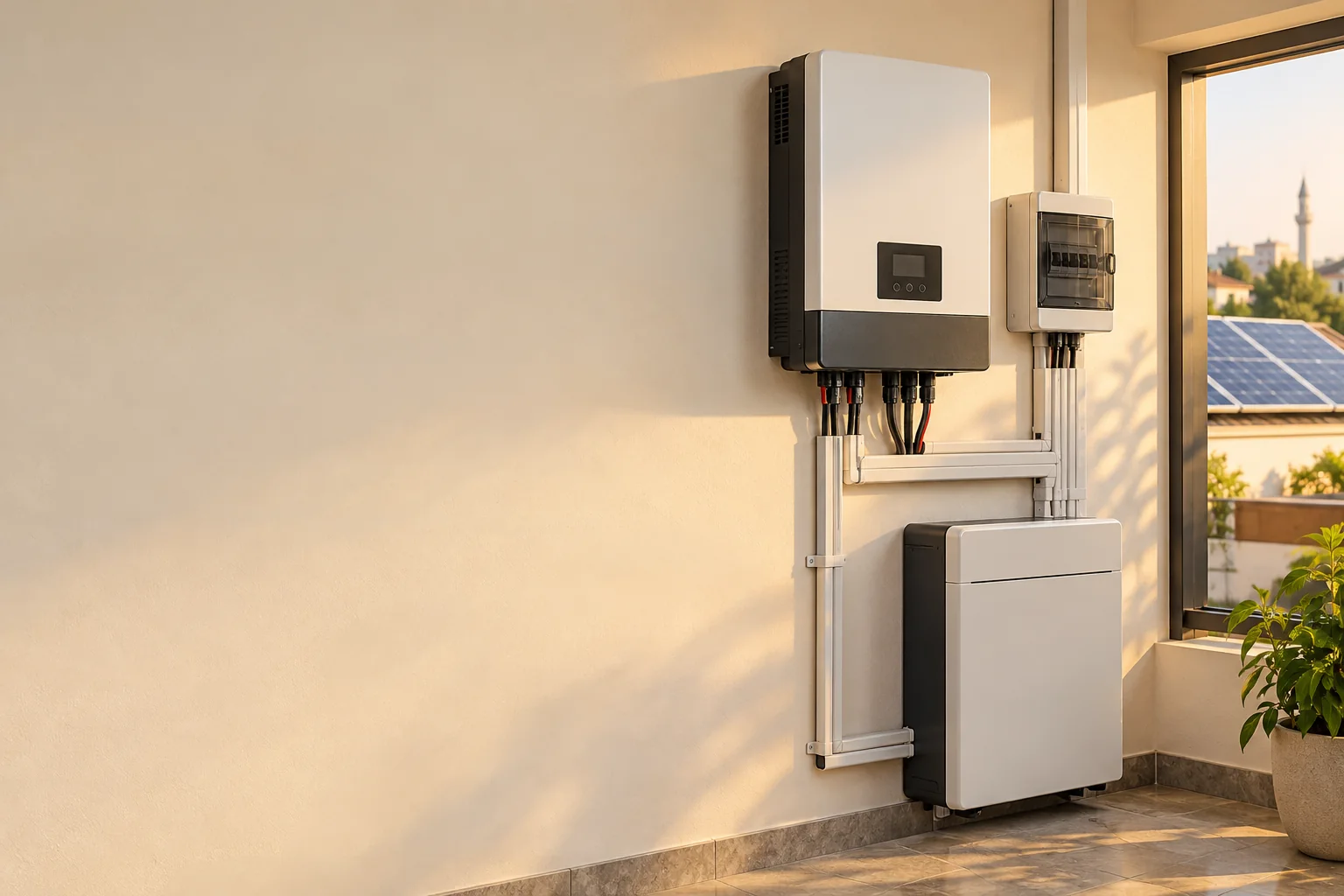
PV Input & MPPT
Match maximum DC voltage, MPPT operating window and input current to the planned strings. High-wattage N-type panels can expose current-limit mismatches in older inverter designs.
Research Deye solar inverter prices in Pakistan with model-family context, inverter types, sizing guidance, battery compatibility checks and practical buying advice. This page focuses on feature-rich hybrid systems with battery integration and flexible energy management.
There is no single Deye inverter price. The final figure depends on capacity, exact model generation, hybrid versus on-grid architecture, phase, number of MPPT trackers, PV input limits, battery support, backup capability, monitoring accessories and warranty channel.
Deye is frequently considered for battery-backed systems, but low-voltage and high-voltage battery architectures are not interchangeable. Match the exact SUN model to the battery bank and phase requirement. Treat dealer prices as time-sensitive quotations and compare the complete model code before assuming two similarly rated inverters are equivalent.
Deye is associated with SUN low-voltage and high-voltage hybrid families. Availability in Pakistan changes over time, so use these families to understand positioning and then verify the exact current model with the seller.
| Model / family | Typical capacity class | Type | Best matched to |
|---|---|---|---|
| SUN 3–6K SG low-voltage class | 3–6kW | Hybrid | Residential backup |
| SUN 8–12K three-phase class | 8–12kW | Hybrid | Larger / three-phase systems |
| Higher-capacity SUN hybrid class | 12kW+ | Hybrid | Large residential / commercial |
Family names and capacities can vary by region and model revision. Always use the manufacturer datasheet for the exact unit offered in Pakistan.
For a meaningful comparison, check battery voltage class, phase, MPPT/current limits, EPS output, parallel operation and genuine stock.
Match maximum DC voltage, MPPT operating window and input current to the planned strings. High-wattage N-type panels can expose current-limit mismatches in older inverter designs.
Choose the phase architecture that matches the property supply and system design. A three-phase inverter is not simply a more powerful version of a single-phase unit.
Low-voltage and high-voltage batteries are different system architectures. Verify voltage range, charge/discharge current and supported BMS communication.
For outage backup, check continuous EPS output, surge behavior, transfer time and whether all loads or only a critical-load circuit will be backed up.
Confirm whether Wi-Fi/LAN hardware is included, what app or portal is used, and whether smart meter or export-control hardware is required.
Ask who handles warranty claims in Pakistan, whether the serial number is recognized, and what proof of purchase and installation documentation is required.
The inverter is the control center of the system, but it must be electrically compatible with the rest of the design. Start with your daily load and backup requirement, then size the PV array and battery around the selected inverter's documented limits.
Calculate string open-circuit voltage at the lowest expected temperature, operating voltage inside the MPPT window, string current and total PV power. Do not assume that a “5kW inverter” must use exactly 5kW of panels; permitted DC oversizing is model-specific.
For lithium storage, confirm nominal voltage, usable capacity, continuous current and BMS protocol. A battery that is electrically close in voltage can still be unsupported for closed-loop communication. See the solar battery price and compatibility guide before choosing storage.
5kW is a common residential search, but inverter sizing should follow simultaneous AC load, solar-array design and backup objectives. Use our solar load calculator to estimate system capacity, then compare the result with the inverter's continuous output and PV-input limits. If you are comparing complete installed systems, review the solar system packages rather than evaluating the inverter in isolation.
It varies by exact model, capacity, hybrid/on-grid design, phase, battery support, accessories and warranty channel. Compare current quotations using the full model code rather than a brand-level price.
Deye has products or market offerings associated with Hybrid, grid-interactive and storage-focused. The exact capability depends on the model family, so verify the datasheet before planning batteries or backup.
The correct size depends on simultaneous load, PV array power, phase and backup requirements. Common residential searches include 3kW, 5kW, 6kW, 8kW and 10kW, but the system should be sized from actual energy use.
Only when the exact inverter and battery are electrically compatible and, where required, support the same BMS communication protocol. Check the manufacturer compatibility documentation.
Potentially, but panel wattage alone is not enough. Verify string open-circuit voltage, MPPT voltage range, per-string input current and total permitted PV input for the exact inverter.
Check the full model code, serial and warranty channel, official datasheet, phase, MPPT limits, PV current, battery support, backup rating, monitoring accessories and installation/protection scope.
That depends on the AC units, compressor starting behavior and all simultaneous loads. For backup operation, also check EPS continuous and surge output plus available battery power.
Not necessarily. Ask whether the quote includes protection devices, cabling, mounting, commissioning, monitoring accessories, batteries and installation labor.
Tell us about your electricity usage, property, and installation requirements. Our solar installation partners will provide a tailored system and installation quote for your home or business.